
A Breakthrough Strategy to Enhance Antisense Oligonucleotide (ASO) Delivery into Cancer Cells
Unlocking New Potential for Gene-Targeting Cancer Therapies
Introduction: Why ASO Delivery Remains a Major Challenge in Cancer Therapy
Antisense oligonucleotides (ASOs) represent one of the most promising classes of gene-targeting therapeutics in modern drug development. By selectively binding to messenger RNA (mRNA), ASOs can block harmful gene expression, making them highly attractive for treating genetic diseases and cancer.
In oncology, ASOs offer the ability to silence oncogenes, inhibit tumor growth, and prevent metastasis. However, despite their therapeutic potential, efficient delivery of ASOs into cancer cells remains a major obstacle. Cancer cells possess protective membrane mechanisms that limit the entry of large, negatively charged molecules like ASOs.
Overcoming this delivery barrier is essential for expanding the clinical utility of antisense therapies beyond current niche applications.
A Novel Drug Delivery Strategy for ASOs
Researchers from Osaka University have now identified an innovative solution to this long-standing challenge. In a study published in Nucleic Acids Research, the research team developed a novel small-molecule compound, known as L687, that significantly enhances ASO uptake into cancer cells.
How L687 Works
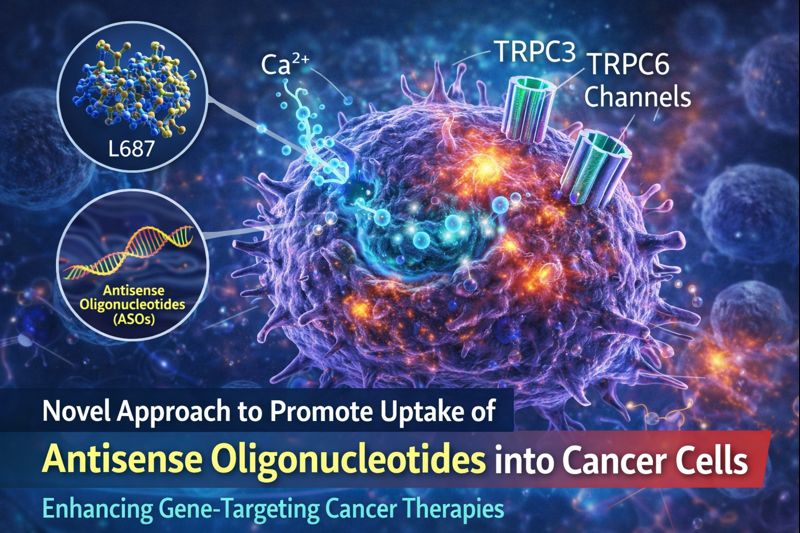
L687 selectively activates TRPC3 and TRPC6 calcium-permeable channels located on the surface of cancer cells. When these channels open:
- Calcium ions flow into the cell
- Calcium signaling triggers cellular uptake mechanisms
- ASOs are efficiently internalized by cancer cells
This mechanism effectively bypasses cellular gatekeeping defenses, enabling targeted delivery of ASOs.
Mechanistic Insight: Calcium Signaling as a Gateway for ASO Uptake
According to lead author Hiroto Kohashi, the research demonstrated that:
“Selective activation of TRPC3/C6 calcium-permeable channels using L687 significantly enhanced ASO uptake in cancer cells, both in vitro and in tumor models in mice. This resulted in strong suppression of target gene activity and improved ASO efficacy.”
Key Findings
- L687 selectively activates TRPC3/C6 channels
- Combination therapy with L687 + ASOs improves intracellular delivery
- Enhanced gene silencing observed in tumor cells
- Improved therapeutic efficacy without genetic modification
This discovery introduces calcium-channel modulation as a powerful and controllable drug-delivery strategy for oligonucleotide therapeutics.
Expanding the Clinical Scope of ASO Therapies
Historically, ASO therapies have been limited to:
- Liver-targeted delivery
- Intrathecal administration (spinal fluid)
- Rare or orphan genetic diseases
The Osaka University findings suggest that L687 could serve as a universal ASO delivery enhancer, extending ASO applications to solid tumors and systemic cancers.
Senior author Masahito Shimojo emphasized:
“Our findings could significantly accelerate the development of ASOs and similar gene-targeting drugs for cancer treatment.”
Targeting Lung and Prostate Cancer: High Translational Potential
The researchers identified lung and prostate cancers as particularly strong candidates for this delivery approach. These cancer types express high levels of TRPC3 and TRPC6 channels, making them especially responsive to L687-mediated ASO uptake.
Implications for Oncology Drug Development
- Identification of new molecular delivery targets
- Improved precision in cancer gene therapy
- Potential combination with existing ASO pipelines
- Reduced need for invasive administration routes
This positions L687 as a next-generation drug delivery platform rather than a standalone therapeutic.
Regulatory and Drug Development Significance
From a drug development and regulatory affairs perspective, this innovation has important implications:
- Enables systemic ASO administration
- Supports development of RNA-based oncology therapeutics
- Aligns with regulatory emphasis on targeted, mechanism-based therapies
- Opens new pathways for translational and first-in-human studies
As antisense and RNA therapies continue to gain regulatory momentum, efficient delivery technologies like L687 will be critical to clinical success.
Conclusion: A Major Step Forward for Gene-Targeting Cancer Therapies
The discovery of L687-mediated ASO delivery via calcium-permeable TRPC3/C6 channels represents a major advancement in antisense oligonucleotide therapeutics.
By overcoming one of the most significant barriers in ASO development—cellular uptake in cancer cells—this approach may dramatically expand the role of gene-targeting drugs in oncology.
Further preclinical and clinical studies will be essential, but this research clearly marks a turning point in RNA-based cancer drug delivery.
References
- Kohashi H, Nagata Y., Kawano Y, et al. (2024). A novel TRPC3/C6 selective activator induces the cellular uptake of antisense oligonucleotides. Nucleic Acids Research, Volume 52, Issue 9, 22 May 2024, Pages 4784–4798. Available at: https://doi.org/10.1093/nar/gkae245.
- Quéméner AM, Centomo ML, Sax SL, et al. (2022). Small Drugs, Huge Impact: The Extraordinary Impact of Antisense Oligonucleotides in Research and Drug Development. Molecules 2022, 27(2), 536. Available at: https://doi.org/10.3390/molecules27020536.
- Khvorova A, Watts JK. (2017). The chemical evolution of oligonucleotide therapies. Nature Biotechnology. Nature biotechnology, 35(3), 238–248. Available at: https://doi.org/10.1038/nbt.3765.