ICH Q5A R1 vs Q5A R2:
What’s New in Viral Safety Evaluation for Biotechnology-Derived Products?
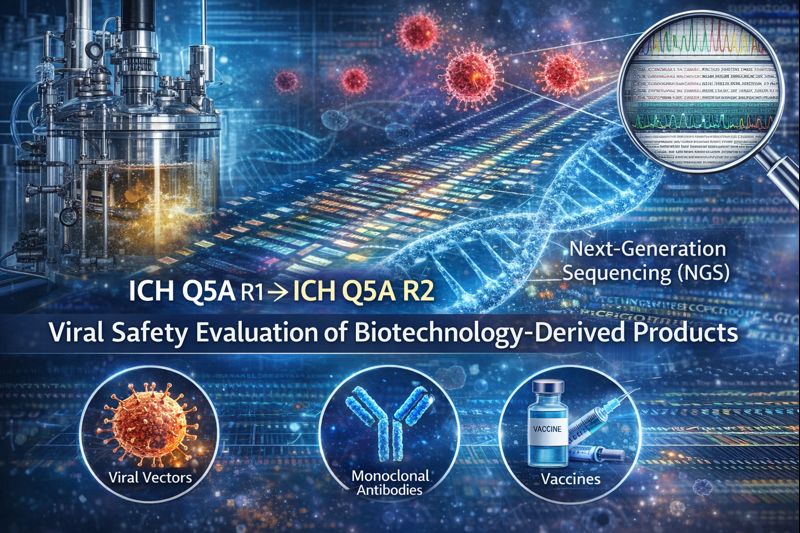
Introduction: Why ICH Q5A Still Matters for Biologics Development
The International Council for Harmonisation of Technical Requirements for Pharmaceuticals for Human Use (ICH) plays a central role in aligning regulatory expectations for the development, approval, and lifecycle management of pharmaceuticals across major global markets, including the United States, Europe, and Japan.
Among its most critical quality guidelines is ICH Q5A, which addresses the viral safety evaluation of biotechnology-derived products produced using cell lines of human or animal origin. These products include monoclonal antibodies, recombinant proteins, vaccines, and viral-vector–based therapies.
With rapid advances in biotechnology, manufacturing platforms, and analytical technologies, the original ICH Q5A(R1) guideline (in place since 1997) required modernization. This led to the release of ICH Q5A(R2)—a substantially revised guideline reflecting current scientific knowledge and regulatory expectations.
Overview of ICH Q5A(R2): Scope and Applicability
The revised guideline, titled:
“ICH Q5A(R2): Viral Safety Evaluation of Biotechnology Products Derived from Cell Lines of Human or Animal Origin”
significantly expands the scope of products and technologies covered.
Product Types Included in Q5A(R2)
- Recombinant proteins produced via in vitro cell culture (e.g., interferons, monoclonal antibodies)
- Products derived from hybridoma cells grown in vivo as ascites
- Genetically engineered viral vectors
- Viral vector–derived products (helper-dependent and independent)
- Virus-like particles (VLPs)
- Recombinant subunit vaccines
- Live attenuated and inactivated viral vaccines containing self-replicating agents
This expansion reflects the evolution of modern biologics and advanced therapy medicinal products (ATMPs).
Key Difference: ICH Q5A R1 vs R2
ICH Q5A(R1) – Legacy Framework (1997)
- Focused primarily on traditional recombinant proteins
- Relied heavily on in vivo animal assays
- Limited coverage of viral vectors and modern platforms
- Batch manufacturing–centric approach
ICH Q5A(R2) – Modernized Guideline
- Incorporates new product modalities
- Introduces risk-based approaches
- Supports next-generation sequencing (NGS)
- Addresses continuous manufacturing
- Emphasizes prior knowledge (PrK) and platform experience
Introduction of Next-Generation Sequencing (NGS)
One of the most transformative updates in ICH Q5A(R2) is the formal recognition of Next-Generation Sequencing (NGS) as a tool for viral safety evaluation.
Why NGS Matters
- Enables broad, unbiased detection of viral contaminants
- Can replace or reduce reliance on in vivo assays
- Aligns with the European 3Rs strategy (Replace, Reduce, Refine animal testing)
- Supports detection of known and unknown adventitious agents
NGS involves DNA or RNA fragmentation (typically 100–300 base pairs) using mechanical, enzymatic, or sonication-based methods, followed by deep sequencing and bioinformatic analysis.
Core Viral Safety Control Strategies in ICH Q5A(R2)
ICH Q5A(R2) continues to emphasize a multi-layered viral safety strategy, built around three primary control elements:
1. Cell Line Selection and Characterization
- Evaluation of master and working cell banks
- Identification of endogenous and adventitious viruses
- Risk assessment of raw materials of biological origin
2. Viral Clearance Evaluation
- Assessment of the manufacturing process capability to remove or inactivate viruses
- Use of downstream viral clearance studies
- Modular validation approaches supported by prior knowledge
3. In-Process and Product Testing
- Viral testing at appropriate manufacturing stages
- Selection of sensitive, validated analytical methods
- Risk-based testing strategies aligned with product knowledge
New Guidance for Viral Vectors and Advanced Platforms
ICH Q5A(R2) provides explicit guidance for viral vector–based products, including:
- Helper virus–dependent systems
- Helper-independent vectors
- Baculovirus, adenovirus, and herpesvirus-based platforms
The guideline advocates a risk-based approach addressing:
- Raw material viral risks
- In-process testing strategies
- Removal/inactivation of adventitious and helper viruses
Continuous Manufacturing: A New Regulatory Consideration
Recognizing the rise of continuous manufacturing (CM), ICH Q5A(R2) highlights that viral safety controls for CM differ fundamentally from batch processes.
Key considerations include:
- System dynamics and residence time
- Monitoring frequency
- Start-up and shutdown risks
- Detection sensitivity over extended operations
Viral safety strategies must be specifically designed for CM environments, not simply adapted from batch paradigms.
Practical Impact for Regulatory & CMC Teams
The revised guideline provides:
- Greater flexibility for well-characterized platforms
- Reduced need for redundant, product-specific validation
- Support for platform approaches and resin reuse
- Clear alignment with modern analytical technologies
For regulatory professionals, ICH Q5A(R2) enables science-based justification while maintaining robust patient safety protections.
Conclusion: Why ICH Q5A(R2) Is a Major Regulatory Milestone
ICH Q5A(R2) represents a significant evolution in viral safety evaluation for biotechnology-derived products. By incorporating NGS, viral vectors, continuous manufacturing, and risk-based principles, the guideline aligns regulatory expectations with modern biopharmaceutical science.
For companies developing biologics, vaccines, or gene and cell therapies, early alignment with ICH Q5A(R2) is essential for global regulatory success.
References
- EMA. ICH Q5A(R2) Guideline on Viral Safety Evaluation of Biotechnology Products Derived From Cell Lines of Human or Animanl Origin (2023). Available at: https://www.ema.europa.eu/en/documents/scientific-guideline/ich-q5ar2-guideline-viral-safety-evaluation-biotechnology-products-derived-cell-lines-human-or-animal-origin-step-5_en.pdf.
- Qin D. (2019). Next-generation sequencing and its clinical application. Cancer Biology & Medicine; February 2019, 16 (1) 4-10. Available at: https://doi.org/10.20892/j.issn.2095-3941.2018.0055.
- ICH Q5A(R1) Quality of Biotechnological Products: Viral Safety Evaluation of Biotechnology
- Products Derived from Cell Lines of Human or Animal Origin (1997). Available at: https://www.ema.europa.eu/en/documents/scientific-guideline/ich-q-5-r1-viral-safety-evaluation-biotechnology-products-derived-cell-lines-human-or-animal-origin-step-5-first-version_en.pdf.
- ICH Q5A(R2) Viral Safety Evaluation of Biotechnology Products Derived from Cell Lines of Human or Animal Origin – Step 2 Presentation (2022). Available at: https://database.ich.org/sites/default/files/ICH%20Q5A%28R2%29_Step2_Presentation_2022_1005.pdf